
City of Rochester Seeks to Add Four Automatic License Plate Readers
Rochester, MN (KROC-AM News)- The Rochester City Council has signed off on applying for a federal grant that would fund more automatic license plate readers in the city.
See Also: Rochester Police Thwart Burglary at Construction Site
Law enforcement uses the automated readers to track stolen vehicles, individuals with active warrants and vehicles involved in missing person cases.
Rochester Police Chief Jim Franklin expressed confidence the city will win the grant based on consistently receiving the funds over the past 10-15 years.
So far Rochester has two automatic license plate readers. Both are stationed along 41st St. NW. The police chief told elected leaders the readers were first implemented to reduce auto thefts in the city.
Franklin told council members the location was chosen based on a “heat map” that showed a pattern of auto thefts in that area.
City Council Authorizes Application for Federal Dollars to Fun Adding Speed Cameras
Based upon the grant formula, which accounts for population and crime rate, the Rochester Police Department is in line to receive $28,188, Franklin indicated.
20% of that total would be allocated to the Olmsted County Sheriff’s Office, which has become a regular occurrence with the grant funds, according to the agenda item.
The money would be used to purchase four additional cameras that would be placed at what the agenda item describes as “strategic locations throughout the City.”
Rules for License Plate Reader Data
A presentation shared with the council indicated the readers would not be used for traffic enforcement and data collected would not be given to third parties.
The only scenario in which Rochester police, which owns all data collected by the readers, would share data is if another law enforcement agency obtained a judicial warrant for information collected by the readers, Franklin said.
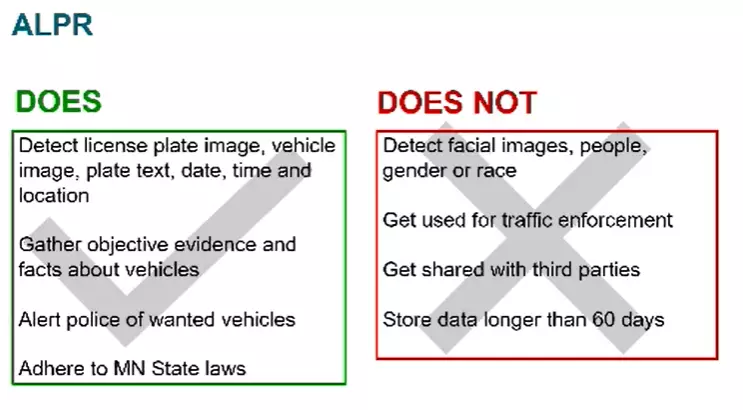
Numerous police departments and sheriff’s offices use the readers through Minnesota, according to the Bureau of Criminal Apprehension. State law allows law enforcement agencies to store the data for a maximum of 60 days.
The Rochester City Council voted unanimously to authorize an application for the grant funding.
10 Under-The-Radar MN Thrift Store Finds That Can Make You Money
Gallery Credit: Paul Shea/TSM
More From KROC-AM